A client says "we need branding" and sends a logo they like as a reference. That is a reasonable way to start a conversation, but it collapses two different jobs into one word. A mark is a symbol and the rules for not breaking it. An identity is a system: the mark plus type, colour, tone, and how all of that holds up on a business card, a slide deck, and a website header. Most people asking for "a logo" actually want the system, and the price difference between the two is not ten percent, it is a multiple.
The opposite mix-up happens too: a company with no physical presence at all, everything on a screen, commissions a full system with packaging rules it will never use. The first real question in a branding brief is not about style, it is about where the brand will actually exist, on a screen only, or on a box, a sign, a uniform. That answer sets the scope before anyone discusses colour.
Identity, or brand platform
Identity. From $2,500. Logo, palette, typography and base rules — the first level you can actually live with: mark, type pairing, and a business collateral set (business card, deck template, social layout). This is the most common order from B2B companies, because they rarely have physical packaging but present to clients and post online every week, and need one consistent look across those channels.
Brand platform. $5,000–12,000. Research, positioning, naming (when needed), identity and a design system with guidelines — a document that lets an outside printer or contractor produce a label correctly without a call to us. It earns its cost when the brand exists on physical objects (packaging, signage, uniforms) or when more than one person, market, or product line has to speak in the same voice.
Within each range, price moves from the low end to the high end based on how many touchpoints are in the set and how many revision rounds the brief allows, and that gets settled at the start, not discovered mid-project.
Why discovery costs more than the drawing
The part of the price that raises questions is rarely the drawing. It is what comes before it: audience research, a look at competitors, and a positioning statement the design has to serve. That stage typically takes a third to half of the project timeline, even when the estimate does not list it as its own line item.
A mark without positioning is a picture nobody can defend in a disagreement. "I don't like it" has no counter-argument if no argument was made in the first place. A mark that grows out of positioning gets discussed on its merits: does it serve the brand's job, not whether one person's taste matches it.
Positioning also outlives the graphics. It feeds the website copy, the investor deck, the brief for the next contractor, long after the mark itself gets redrawn in a rebrand. Skipping this stage looks like it saves a week. In practice it moves that week to the end of the project, because without a shared criterion, revisions circle indefinitely on taste alone.
When a brand platform is overkill
A brand platform, a written positioning, mission, values and tone of voice, is not always necessary. A small company with one product and a clear audience can work from a short brief before design starts: who the customer is, what sets the company apart, what tone fits.
A platform earns its cost when the brand has to speak with one voice in more than one place: several product lines, several markets, a marketing team past three people. Without it written down, every new hire or agency invents the tone again, and a year in, the brand is speaking five different ways at once.
Getting a quote
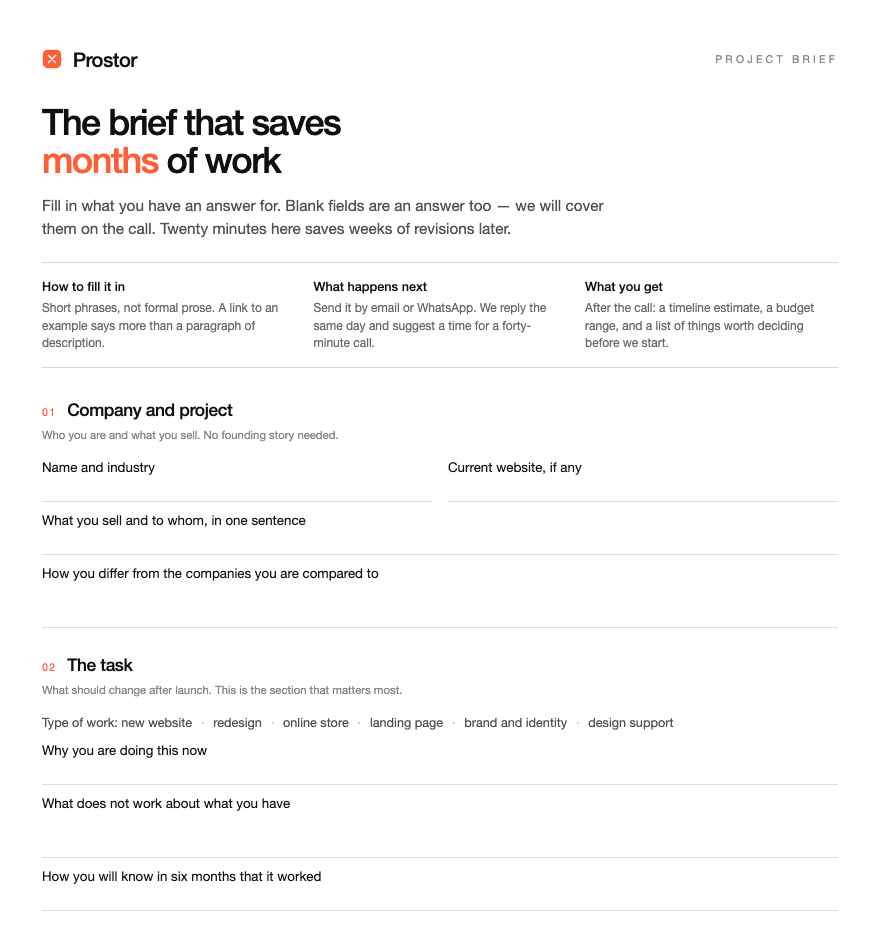
Scoping and pricing for your project happens on a call, not from a price list, because the touchpoint count and the research depth change the number. Start on the branding page, and if the project includes a new website, say so up front: the discovery work gets scoped once, not twice.